Saturday, October 02, 2010

Welcome to Brunswick Street


One of the famous statues of Peter Corlett, Called " Mr Poetry "
 1994, Cast Iron, Life size, Concrete Plinth 2.5 metre high.

See more sculptured of Peter Corlett from my old posted : Fortuna 1992

Thursday, September 30, 2010

The Travellers


The Travellers
Artist Nadim Karam; manufacturer Arup Engineering
Stainless-steel tubing and glass panel installation, 2005 
Sandridge Bridge, Yarra River 

The Travellers celebrates Indigenous presence and the meeting of cultures through migration. It comprises 10 large-scale sculptures, each approximately 7.5 metres tall and collectively incorporating 3.7 kilometres of stainless steel. Nine of the 10 figures are motorised and at regular intervals move along the length of Sandridge Bridge, sited near a former Aboriginal meeting ground and near the landing point where many early migrants stepped ashore. Built in 1888, the bridge is the third to occupy this site, the original constructed in 1853.

Designed by Beirut-based artist Nadim Karam, The Travellers tells a history of migration to Australia. Each of the 10 figures comprising the work represents a phase of arrival, as historian James Jupp has defined these. The figures, graphic and abstracted in form, are Gayip (Aboriginal period); First Settler (convict period); Melbourne Beauty (gold rushes); Walker and His Tucker Bag (assisted migration); Shelter (displaced persons); Urban Wheel (European migration); Running Couple (refugees); Butterfly Girl (Asian and Middle Eastern migration); Technoman (students and professionals); and Walking Sun (multiculturalism). Below the figures, a series of etched glass panels stretch across the bridge, a component in this history of migration to Australia.

This work was commissioned by the City of Melbourne and Victorian government, and launched in 2005.

See more of The Travellers sculptures from my old posted : Look Across Sandridge Bridge to Crown Casino

Wednesday, September 29, 2010

The Argus Building


The Argus building, constructed in 1926 on the corner of La Trobe and Elizabeth streets, is classified by the National Trust and is on the Victorian Heritage Register of Heritage Victoria. In 1991, an innovative office building was built next door and named The Argus Centre, an award winning building by Nonda Katsalidis. In 2004 La Trobe University bought the site of the old Argus building with the intention to redevelop and house legal and business schools in the building, as well as a ground floor shopping precinct.

Monday, September 27, 2010

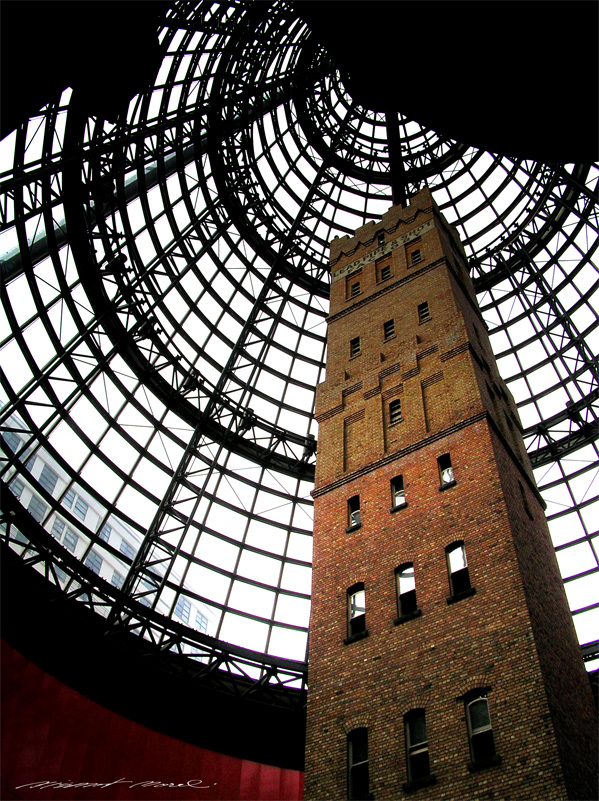
Look up to see the Lead Pipe and Shot Factory


The place known as COOPS SHOT TOWER AND FLANKING BUILDING KNOX PLACE MELBOURNE [ Now incorporated in Melbourne Central ]


Coop’s Shot Tower and Flanking Building were erected in 1889-90 and consist of a two storey, three bay brick structure dominated by a fifty metre high castellated tower. The Tower was used for the manufacture of lead shot until closing in 1960. It remained unoccupied until being incorporated into the Melbourne Central shopping centre in the late 1980s-early 1990s.

Coop’s Shot Tower and Flanking Building are of historical and architectural significance to the State of Victoria.

Coop’s Shot Tower and Flanking Building are of historical significance as evidence of an early industrial process, and for their association with the Coop family, who had extensive interests in shot manufacture and smelting – they owned both of the two remaining towers in Melbourne, the other being in Clifton Hill. The tower provides tangible evidence of the original process of lead shot production, a process now largely forgotten. Its form reflects the shot production process: the shot was produced by dropping molten lead through sieves at the top of the tower into water at the bottom. The height of the Tower was necessary to allow the shot to form into spheres before reaching the bottom. At the height of its productive life, the Tower was producing six tons of shot per week. Also manufactured in the associated buildings were a diverse range of lead products, including nails, washers, sheeting, tubes, pipes and solder for leadlighters and plumbers.

Coop’s Shot Tower and Flanking Building are of historical significance as a reminder of the character of the 19th century city, in which residential, commercial and industrial uses existed in close proximity. There are now few remaining traces of central Melbourne’s industrial past, giving the shot tower added importance.

Coop’s Shot Tower and Flanking Building are of architectural significance as a fine example of a rare and distinctive building type and as a Melbourne landmark for more than a century. The Tower was one of the tallest buildings in Melbourne for many years, second only to the shot tower in Clifton Hill, and remained a significant Melbourne landmark long after its closure. The building is carefully massed with its campanile-style central tower above the two storey factory with fine arched openings.
Related Posts with Thumbnails