The Argus building, constructed in 1926 on the corner of La Trobe and Elizabeth streets, is classified by the National Trust and is on the Victorian Heritage Register of Heritage Victoria. In 1991, an innovative office building was built next door and named The Argus Centre, an award winning building by Nonda Katsalidis. In 2004 La Trobe University bought the site of the old Argus building with the intention to redevelop and house legal and business schools in the building, as well as a ground floor shopping precinct.
Showing posts with label Heritage. Show all posts
Wednesday, September 29, 2010
The Argus Building
Labels:
Building,
City,
Heritage
Posted by
Boom Nisanart
at
Wednesday, September 29, 2010
10
comments
Monday, September 27, 2010
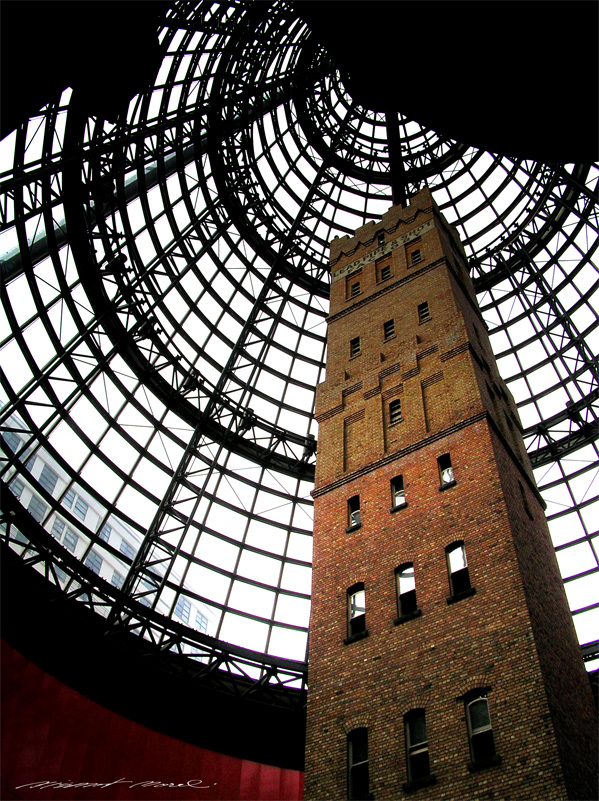
Look up to see the Lead Pipe and Shot Factory
The place known as COOPS SHOT TOWER AND FLANKING BUILDING KNOX PLACE MELBOURNE [ Now incorporated in Melbourne Central ]
Coop’s Shot Tower and Flanking Building were erected in 1889-90 and consist of a two storey, three bay brick structure dominated by a fifty metre high castellated tower. The Tower was used for the manufacture of lead shot until closing in 1960. It remained unoccupied until being incorporated into the Melbourne Central shopping centre in the late 1980s-early 1990s.
Coop’s Shot Tower and Flanking Building are of historical and architectural significance to the State of Victoria.
Coop’s Shot Tower and Flanking Building are of historical significance as evidence of an early industrial process, and for their association with the Coop family, who had extensive interests in shot manufacture and smelting – they owned both of the two remaining towers in Melbourne, the other being in Clifton Hill. The tower provides tangible evidence of the original process of lead shot production, a process now largely forgotten. Its form reflects the shot production process: the shot was produced by dropping molten lead through sieves at the top of the tower into water at the bottom. The height of the Tower was necessary to allow the shot to form into spheres before reaching the bottom. At the height of its productive life, the Tower was producing six tons of shot per week. Also manufactured in the associated buildings were a diverse range of lead products, including nails, washers, sheeting, tubes, pipes and solder for leadlighters and plumbers.
Coop’s Shot Tower and Flanking Building are of historical significance as a reminder of the character of the 19th century city, in which residential, commercial and industrial uses existed in close proximity. There are now few remaining traces of central Melbourne’s industrial past, giving the shot tower added importance.
Coop’s Shot Tower and Flanking Building are of architectural significance as a fine example of a rare and distinctive building type and as a Melbourne landmark for more than a century. The Tower was one of the tallest buildings in Melbourne for many years, second only to the shot tower in Clifton Hill, and remained a significant Melbourne landmark long after its closure. The building is carefully massed with its campanile-style central tower above the two storey factory with fine arched openings.
Thursday, September 09, 2010
Regent Theatre
The Regent Theatre in Melbourne has had four phases in its existence. It was initially built as a grand picture palace for Frank Thring Senior's Hoyts cinema chain. The design by Cedric H. Ballantyne was not intended as high art but as a place to evoke fantastic faraway times and places to which anyone could escape for the price of a ticket. As such it has endeared itself to several generations of Melbournians.
The Regent opened on 15 March 1929 and in the manner of grand picture palaces of the time was designed for a mixture of film and live entertainment including a Wurlitzer organ. The Plaza Ballroom underneath had been redesigned to cater for the new talking pictures and opened later the same year.
The Regent Mark I ended abruptly with a disastrous fire on 28 April 1945 which completely destroyed the auditorium. Remarkably, the Plaza was hardly damaged and with some sealing work was able to reopen soon afterwards.
The decision was made to rebuild the Regent. Some designs were changed but the spirit of the original building was maintained and despite the austerity of the times the Regent Mark II was reopened on 16 December 1947. The organ was replaced and again the regent could be marketed as 'The Palace of Dreams'. However the advent of television and changing public tastes during the 1960s were inevitably tolling the death knell of the great picture palaces around Australia. Numbers of adaptations were made - the Plaza briefly became a Cinerama cinema but by 1970 both the Regent and the Plaza were closed and all the furniture and fittings auctioned off.
Then began a period when the deserted Regent became the centre of public debate. it had been bought by the Melbourne City Council who had intended to demolish it to create (or enlarge) a city square. However many Melbournians wanted this piece of Melbourne's heritage to be maintained. Numbers of groups became involved including building unions who placed a 'green ban' on its demolition. Various uses for the building were mooted but in 1993 the State Government and Melbourne City Council announced it would be rebuilt as a theatre.
The newly refurbished theatre suitable for major theatre productions was reopened on 19 August 1996 with the Plaza refurbished as a ballroom. It is the Regent Mark III which now stands in Collins Street. It retains much of its original character, and appropriately enough also has a Wurlitzer organ Mark III.
Click this link see : the detailed information on the organ at the Regent Theatre
Monday, August 09, 2010
Stanford Fountain
By William Stanford
Bluestone fountain, 1870
Gordon Reserve, corner of Spring and Macarthur Streets
William Stanford's bluestone fountain features a boy on the upper tier, encircled by birds and fish on the lower tier. But this scene of innocence was created in a far less naive setting.
Stanford was apprenticed to a London stonemason before coming to Australia to try his luck on the Bendigo goldfields. When he failed to make his fortune, he turned to horse stealing, and in 1854 was imprisoned for 10 years. He was released after six on ticket-of-leave, but was soon found guilty on two charges of highway robbery and another of horse stealing. The sentences amounted to a total of 22 years, two of which were served as hard labour in irons after Stanford broke out of a supposedly 'escape-proof' gaol in 1861. In Melbourne's Pentridge Prison, Stanford's talent for drawing and carving was recognised - he carved bones left over from stews - and the prison governor allowed him to turn his hand to carving stone. Local sculptor Charles Summers tutored Stanford, who soon set to carving a fountain from bluestone from the prison quarry, which was the only material available to him. He modelled the fountain's avian adornments on a stuffed eagle-hawk and modelled the boy on the governor's son.
The fountain was installed in Carpentaria Place (now known as Gordon Reserve) in 1871, following Stanford's release after he - and his friends petitioned for this on the grounds of his ill health. The Illustrated Australian News claimed the fountain was 'not only a work of great beauty but...executed under circumstances of extreme difficulty [which for] most men would have been insurmountable'. Stanford received no payment for the fountain but in time became a respected citizen; he established a business in Windsor, which had a reputation for creating fine headstones.
Stanford died in 1880 from 'stonemasons' disease', having inhaled a surfeit of fine dust while creating his beautiful fountain.
Wednesday, August 04, 2010
The Old Former Prahran Arcade
The old Former Prahran Arcade is on Chapel street. Built in 1889 is a richly detailed building both externally and internally in beautiful Victorian Baroque style. Retains the original arcade, but decorative roof was removed in the 1950s. Also known locally as "Birdland" due to pigeons which once bred in the recessed balconies of the building and the large eagles which adorn the facade. Was a Dan Murphy's cellar for many years, but currently a JB Hifi store and the clothing store.
I think most of the people when they look up and see this, They will wish the same as me that someone would restore it but there hasn't been any thread for long time until now. That is a sad thing for me.
Labels:
Building,
Heritage,
Prahran
Posted by
Boom Nisanart
at
Wednesday, August 04, 2010
8
comments
Tuesday, July 27, 2010
The Century Building
The Century Building (1938-40) is Marcus Barlow’s vertical Streamlined Moderne updating of his Modern Gothic Manchester Building on the next corner completed 6 years earlier.
With its abstracted corner tower, uninterrupted vertical fins and boldly horizontal and stepping streamlined canopy (the soffit is particularly notable), the limit-height Century Building is smartly Moderne. Common to both buildings, however, was the external cladding material: faience-glazed terracotta tiles, which Barlow used frequently as they provided a permanent and impervious finish. Wunderlich Limited, producers of faience, used the Century Buiilding in their advertisements, saying of it: ‘it gives a permanent freshness and sparkle to this fine building. Window spandrels are in hand moulded terracotta glazed neutral grey to achieve an arresting architectural contrast’.
Wednesday, July 14, 2010
Love and Lewis Building
This old building is on Prahran street. Built in 1913 ( the Interwar period), in the Chicagoesque style. Now converted into a mix of offices, retail and apartments in 2004.
Thursday, July 08, 2010
The Manchester Unity Building
The Manchester Unity Building (1932) located on the north-west corner of the intersection of Collins Street and Swanston Street. by Marcus Barlow
I love this building. It's a marvelous skyscraper. It's not too hard to find an information. but the confused information is....the style of this building. Some say " it's an art deco skyscraper " Some say " it's a Neo-Gothic skyscaper " And then I checked with the Victorian Heritage Database. It's a Neo-Gothic !
Read more about this building, please click link : The Manchester Unity Building
Labels:
Building,
Heritage,
Neo-Gothic
Posted by
Boom Nisanart
at
Thursday, July 08, 2010
5
comments
Monday, July 05, 2010
The Prince Alfred’s Tower
The Prince Alfred’s Tower, part of the Melbourne Town Hall building, can be seen the Town Hall clock, which was made 4 years after the town hall's completion. Designed by Smith and Sons of London, the clock was presented to the Council by Vallange Condell, son of Melbourne's first Mayor, on 1874. The clock measures 8 feet in diameter and its hands, which are purely made from copper, measure 3 feet and 10 inches long (for the longer hand) and weighs 8.85 kilograms.
Aside from the clock, also inside the town hall are two grand organs, which were installed in 1872. Unfortunately, a few decades later, specifically in 1925, the town hall was subject to a huge fire, destroying a great part of the place, including the main auditorium and one of the two organs. The burned part of the town hall, along with the piano, was then rebuilt and refurnished. The auditorium, on the other hand, was overhauled and enlarged.
Though not all features of the burned town hall were replaced, like the mansrad roof, the Melbourne Town Hall is still known for its classy interiors. Designed by architects Kennedy Grainger and Yulle, the building's interiors reflect a mixture of Italian and English inspirations dating from the 1500 to 1800. Inside the town hall can also be found furniture and other pieces made with the style and elegance of the building itself.
Labels:
Building,
City,
Heritage,
Town Hall
Posted by
Boom Nisanart
at
Monday, July 05, 2010
4
comments
Saturday, June 26, 2010
Cathedral Arcade
Cathedral Arcade is a heritage shopping arcade in Melbourne, Victoria.
It forms a short, narrow laneway, connecting Swanston Street to Flinders Lane in the central business district of Melbourne. It is a T-shaped arcade, however one of the laneways terminates inside of the building.
The arcade is notable as it retains all of its original features. The arcade is fully covered by stained glass and leadlights, which forms a highly detailed arch leading to a central dome. The floors are decorated with ceramic tiles, and the shopfronts feature richly detailed wood panels.
The art deco arcade, which dates back to 1925 is part of the Nicholas Building designed by Harry Norris. The building itself, including the arcade is listed on the Victorian Heritage Register.
Labels:
Arcade,
City,
Heritage,
Shopping
Posted by
Boom Nisanart
at
Saturday, June 26, 2010
11
comments
Thursday, June 24, 2010
Causeway Lane
Causeway Lane (also known as The Causeway) is a street in Melbourne, Victoria. It is a short, quiet and narrow openlaneway, running between Bourke Street Mall and Little Collins Street between Elizabeth Street and Swanston Street in the central business district of Melbourne.
Located in the heart of the shopping precinct, the Causeway is currently flanked by some small boutique shops, indoor and outdoor cafes and sushi bars.
The lane is notable for the heritage listed former Union Bank a tall curved palazzo styled building constructed in the 1920s which has a mezzanine entrance at the corner of the lane. The building is now occupied by Laurent, an upmarket French patisserie.
Labels:
Food,
Heritage,
Lane ways,
restaurant,
Shopping
Posted by
Boom Nisanart
at
Thursday, June 24, 2010
7
comments
Sunday, June 20, 2010
Monday, May 24, 2010
The Grand Victorian era hotel
Hotel Windsor is Australia’s only surviving grand 19th century city hotel and only official "grand" Victorian era hotel. There is a history, please see detail in this link : Hotel Windsor
Thursday, May 20, 2010
One of Victorian Heritage
I walked on Russel toward to Latrobe street and captured this old art deco building. And I just wonder what is this place ? ... found out later on. This building name is " Russell Street Police Headquarters Complex ". Original build for office use but now is for Residential ( apartments ) .The art deco style of this architecture is very rare example of an early stepped geometric New York or Los Angeles style skyscraper. And if you love art deco and would like to know more, please click this link : Russell Street Police HQ
Friday, April 16, 2010
The most recognisable landmarks
Labels:
Attractions,
Flinder,
Heritage,
station,
transportation
Posted by
Boom Nisanart
at
Friday, April 16, 2010
0
comments
Labels:
Flinder,
Heritage,
station,
transportation
Posted by
Boom Nisanart
at
Friday, April 16, 2010
0
comments
Thursday, April 15, 2010
GPO Burke Street
Labels:
Attractions,
Building,
City,
Heritage
Posted by
Boom Nisanart
at
Thursday, April 15, 2010
0
comments
Labels:
Attractions,
Building,
City,
Heritage
Posted by
Boom Nisanart
at
Thursday, April 15, 2010
1 comments
Tuesday, April 13, 2010
Princes Bridge is a historic bridge that crosses the Yarra River in Central Melbourne, Australia. It is built on the site of one of the oldest river crossings in Australia, being the third bridge on the same location,
the first was built in 1844 and the current bridge was built in 1888, making it over 120 years old. The bridge connectsSwanston Street on the Yarra River's northern bank to St Kilda Road on the southern bank, and carries, road,tram and pedestrian traffic. The bridge is listed on the Victorian Heritage Register.
Because of its position, Princes Bridge is often a focal point for celebratory events in Melbourne such as theMoomba Festival, New Years Eve and many celebrations taking place on the Yarra River where it flows through the city.
Sunday, April 11, 2010
Quite day in Flagstaff Park
Flagstaff Gardens is the oldest park in Melbourne, Victoria, Australia, first established in 1862. In 2005 it is one of the most visited and widely used parks in the city by nearby office workers and tourists
Feel fresh when you in the park
Subscribe to:
Comments (Atom)