
Saturday, October 23, 2010

Tuesday, October 19, 2010
Degraves Laneway

Degraves Street is a street in Melbourne, Victoria. It is named after Charles and William Degraves, pioneer merchants who settled in Melbourne from Hobart, Tasmania in 1849. William Degraves (1821-1883) was also a large-scale grazier and a member of Victoria's Legislative Council between 1860 and 1874.
It is a short, narrow laneway, running north from Flinders Street to Flinders Lane in the central business district of Melbourne. The cobbled bluestone alley forms a busy alternative thoroughfare for commuters disembarking fromFlinders Street Station toward the shopping areas of The Block on Collins Street and Bourke Street Mall, loosely connecting with Centre Place, a similar lane just across Flinders Lane. The Degraves underpass was built in the 1950s, one of the few public works at the time, to allow pedestrians to get from Flinders Street Station to Degraves street rather than have to walk across busy Flinders Street. Degraves underpass is also home to Platform Artists Group, and frequently presents new works.Vehicles have only restricted access.
The lane features bars, cafes, and restaurants and many of the taller old buildings have been converted into loft style apartments in the 1990s, adding further life to the street.
Redevelopment of the Mutual Store in 2006 has further enhanced the lane with additional shops.
A vista up Degraves laneway is created by "Majorca House", an ornate 1930s building dressed in faience.
People use Degraves Street as a quick stop for a coffee before going to catch their train at Flinders Street Station.
Sunday, October 17, 2010

Wednesday, October 13, 2010
Listening to the music

Miraggio (aka Seated Figure)
By Pino Conte : Bronze statue, 1964
Sidney Myer Music Bowl, Kings Domain
Miraggio, a bronze statue of a slender young woman listening to music, came into the city’s public art collection 1964. An anonymous ‘Lover of Italy’ donated it to the Sidney Myer Music Bowl Trust and Melbourne City Council. Following the re-landscaping of the site, Miraggio was reinstalled in October 2001. To be faithful to the donor’s wishes and the apparent intent behind the work, the figure is installed as if she were part of the audience.
Sunday, October 10, 2010

Friday, October 08, 2010
In the Sky

“In the sky, there is no distinction of east and west; people create distinctions out of their own minds and then believe them to be true.”
Buddha quotes (Hindu Prince Gautama Siddharta, the founder of Buddhism, 563-483 B.C.)
Skywatch Friday
Skywatch Friday
Tuesday, October 05, 2010

Saturday, October 02, 2010
Welcome to Brunswick Street

One of the famous statues of Peter Corlett, Called " Mr Poetry "
1994, Cast Iron, Life size, Concrete Plinth 2.5 metre high.
See more sculptured of Peter Corlett from my old posted : Fortuna 1992
Friday, October 01, 2010

Thursday, September 30, 2010
The Travellers

The Travellers
Artist Nadim Karam; manufacturer Arup Engineering
Stainless-steel tubing and glass panel installation, 2005
Sandridge Bridge, Yarra River
The Travellers celebrates Indigenous presence and the meeting of cultures through migration. It comprises 10 large-scale sculptures, each approximately 7.5 metres tall and collectively incorporating 3.7 kilometres of stainless steel. Nine of the 10 figures are motorised and at regular intervals move along the length of Sandridge Bridge, sited near a former Aboriginal meeting ground and near the landing point where many early migrants stepped ashore. Built in 1888, the bridge is the third to occupy this site, the original constructed in 1853.
Designed by Beirut-based artist Nadim Karam, The Travellers tells a history of migration to Australia. Each of the 10 figures comprising the work represents a phase of arrival, as historian James Jupp has defined these. The figures, graphic and abstracted in form, are Gayip (Aboriginal period); First Settler (convict period); Melbourne Beauty (gold rushes); Walker and His Tucker Bag (assisted migration); Shelter (displaced persons); Urban Wheel (European migration); Running Couple (refugees); Butterfly Girl (Asian and Middle Eastern migration); Technoman (students and professionals); and Walking Sun (multiculturalism). Below the figures, a series of etched glass panels stretch across the bridge, a component in this history of migration to Australia.
This work was commissioned by the City of Melbourne and Victorian government, and launched in 2005.
See more of The Travellers sculptures from my old posted : Look Across Sandridge Bridge to Crown Casino
Wednesday, September 29, 2010
The Argus Building

The Argus building, constructed in 1926 on the corner of La Trobe and Elizabeth streets, is classified by the National Trust and is on the Victorian Heritage Register of Heritage Victoria. In 1991, an innovative office building was built next door and named The Argus Centre, an award winning building by Nonda Katsalidis. In 2004 La Trobe University bought the site of the old Argus building with the intention to redevelop and house legal and business schools in the building, as well as a ground floor shopping precinct.
Tuesday, September 28, 2010

Monday, September 27, 2010
Look up to see the Lead Pipe and Shot Factory
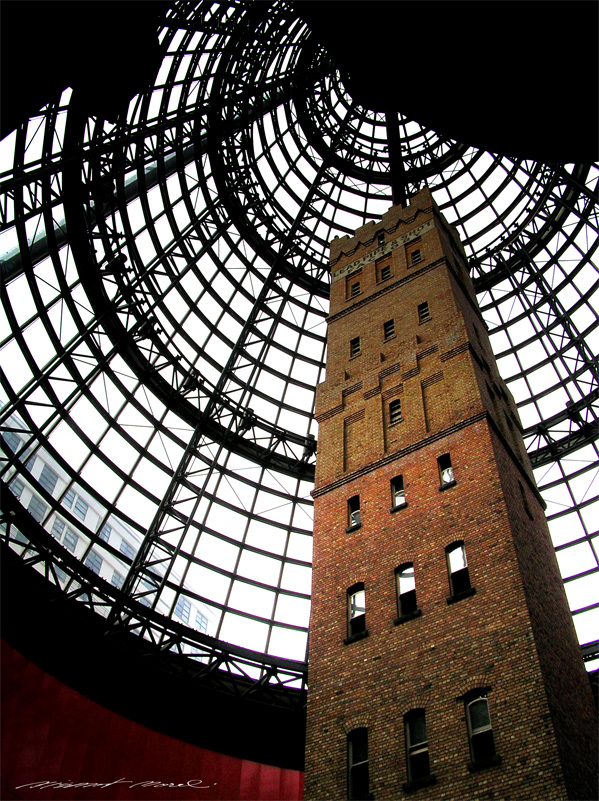
The place known as COOPS SHOT TOWER AND FLANKING BUILDING KNOX PLACE MELBOURNE [ Now incorporated in Melbourne Central ]
Coop’s Shot Tower and Flanking Building were erected in 1889-90 and consist of a two storey, three bay brick structure dominated by a fifty metre high castellated tower. The Tower was used for the manufacture of lead shot until closing in 1960. It remained unoccupied until being incorporated into the Melbourne Central shopping centre in the late 1980s-early 1990s.
Coop’s Shot Tower and Flanking Building are of historical and architectural significance to the State of Victoria.
Coop’s Shot Tower and Flanking Building are of historical significance as evidence of an early industrial process, and for their association with the Coop family, who had extensive interests in shot manufacture and smelting – they owned both of the two remaining towers in Melbourne, the other being in Clifton Hill. The tower provides tangible evidence of the original process of lead shot production, a process now largely forgotten. Its form reflects the shot production process: the shot was produced by dropping molten lead through sieves at the top of the tower into water at the bottom. The height of the Tower was necessary to allow the shot to form into spheres before reaching the bottom. At the height of its productive life, the Tower was producing six tons of shot per week. Also manufactured in the associated buildings were a diverse range of lead products, including nails, washers, sheeting, tubes, pipes and solder for leadlighters and plumbers.
Coop’s Shot Tower and Flanking Building are of historical significance as a reminder of the character of the 19th century city, in which residential, commercial and industrial uses existed in close proximity. There are now few remaining traces of central Melbourne’s industrial past, giving the shot tower added importance.
Coop’s Shot Tower and Flanking Building are of architectural significance as a fine example of a rare and distinctive building type and as a Melbourne landmark for more than a century. The Tower was one of the tallest buildings in Melbourne for many years, second only to the shot tower in Clifton Hill, and remained a significant Melbourne landmark long after its closure. The building is carefully massed with its campanile-style central tower above the two storey factory with fine arched openings.
Sunday, September 26, 2010

Saturday, September 25, 2010

Friday, September 24, 2010
Good Morning Flagstaff gardens

Cheerful people are like sunlight,
They shine in to the corners of the heart and offer bright mornings and fresh hopes.
Thursday, September 23, 2010

Wednesday, September 22, 2010

Tuesday, September 21, 2010
The Guardians

The Guardians, by Simon Rigg were unveiled in November at Melbourne's Southgate precinct near the Crown Casino, the commissioning body.
These two monumental abstract sculptures carved from Italian statuary marble and clad with ceramic tiles with 6.7m high. The square based mounting of the large statue depicts the four elements. The smaller Guardian reveals a woman's head looking through the hole of the larger sculpture, and hints at the source of all the images, beyond our plane of vision.
Monday, September 20, 2010
Dawn in the city

Weathervanes
Daniel Jenkins
Hand-beaten copper sculpture with gold-leaf detail, 1993
Cnr Bourke & Swanston Street
Daniel Jenkins was born in Kansas, USA, in 1947, and arrived in Australia in 1981. He studied extensively in Europe, and is a jeweller and silversmith by trade. The technique Jenkins employed on Weathervanes is repoussé, where the metal is beaten from its underside to give shape and relief to the design. Jenkins acquired the technique while visiting Venice on a Palladio Foundation scholarship.
Each of the four weathervanes takes the shape of an animal: a horse, pig, fish and bird. They are positioned high on tram poles to give aerial performances with each gust of wind. The vanes have been conceived to represent specific aspects of Melbourne: the bird symbolises the city’s parks and gardens; the horse symbolises its culture and sport; the fish refers to its waterways; and the pig represents the city’s hope and future – the latter a tongue-in-cheek reference to ‘pigs can fly’. Jenkins said of the sculpture, ‘I wanted each of these weathervanes to be cartoon-like and even frivolous. We take our cities for granted and with the daily pedestrian bustle it is always business as usual. It takes something very unusual to attract someone’s eye. I want people to look up and smile!’
The City of Melbourne commissioned Jenkins to make this work, which took him four months to complete. Lord Mayor Councillor Des Clark unveiled Weathervanes in March 1993.
Subscribe to:
Posts (Atom)
